
Me and Yama Mama

Updated: Aug 11
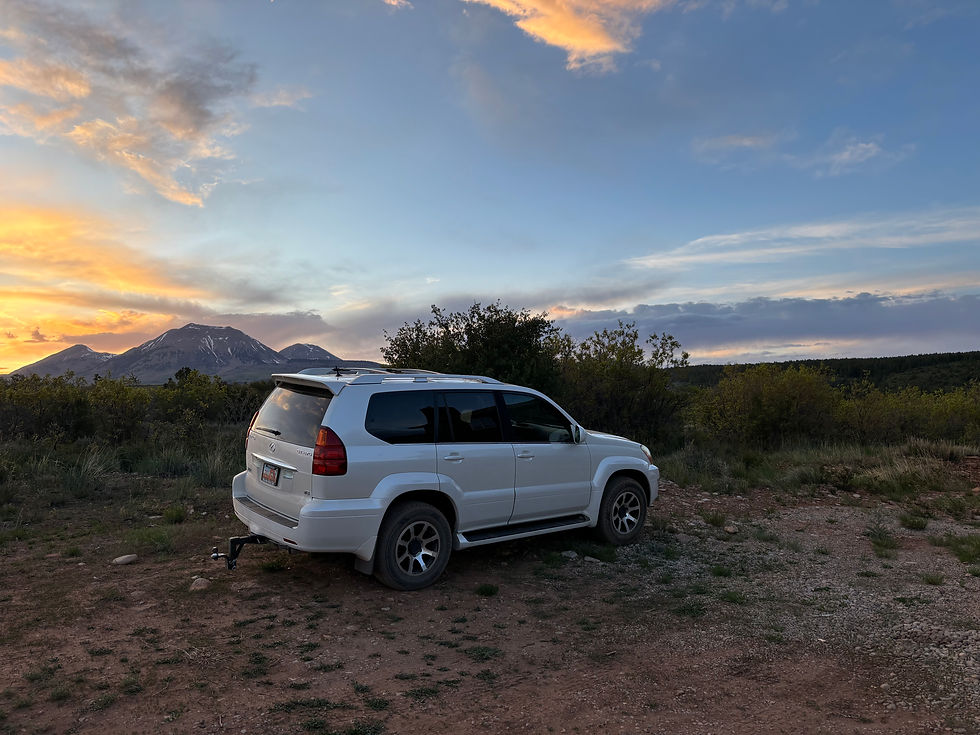
Earlier this year, I bought a 2006 Lexus GX470. She came with heated leather seats, a sunroof, and just enough sass to be dangerous. I named her Yama Mama, which means “Mountain Mama” in Japanese, her native tongue. She is destined for rough roads, high altitudes, and overlanding adventures. I told my husband, Cameron, I got a great deal.
I was wrong.
She broke down on the freeway while Cam and the girls, Olivia and Ruby, were taking her out for a spin. That night, I got a text from Ruby:
“Yama hath done us wrong.”
The alternator had given up in the middle of the freeway, and they were stranded in rush hour traffic. Cam was too frustrated to call me himself. Ruby had to break the news, which felt somehow more dramatic, like I’d failed as a car buyer, a wife, and a parent.
The thing is, I knew Yama needed some work when I bought her. I even budgeted for a new muffler. What I didn’t budget for was the full exhaust system, suspension, brakes, air conditioning lines that leaked like a sieve, or, of course, the temperamental alternator. My little project ended up taking me three mechanics, four months, and the patience of a woman trying to box breathe through a toddler tantrum. Somewhere around the third prognosis of, “This should only take a few days,” and I still didn’t feel like I could give up, I realized I wasn’t just rebuilding an SUV. I was rebuilding something in me, too.
Cam, for the record, was deeply unimpressed. Which felt a little hypocritical coming from a man who once bought a 43-passenger bus off a vehicle auction site because "it was a really good deal." I was in Oxford at the time, visiting friends. He got lonely and, as one does, consoled himself by impulse-purchasing mass transit. He thought maybe his beloved nonprofit drum corps, The Battalion, could use it. Or, even better, maybe we’d convert it into a glamper and sell it. What actually happened was: it sat idle in storage for two years until the facility closed, and then it got parked in front of our house. A literal bus. On the street. In front of my home. Like a tombstone for impulse control.
So when I bought a 20-year-old SUV for overlanding, Cam thought the universe had finally delivered his justification. And when the repair bills rolled in, he looked vindicated in a way that only a man who once bought a bus can. I still don’t love the bus. He still doesn’t love the Lexus. But I like to think we’re inching toward a truce between two fallible humans navigating midlife mishaps, mechanical and otherwise.
Cam and I have never had a season without kids in the house. We got married when our daughters were 11 and 14. He’s amazing, and so is our life, but we’ve never been "just us." We’re still learning how to be together when we’re not coordinating carpools. And sometimes we still retreat to the safe ground of errands, home improvement, or reorganizing the junk drawer, because we don’t know the answers yet for the deeper questions: what are we like without the kids? And where are we going with just the two of us?
Once I got her running, though, Yama Mama became more than just a car. She became a vehicle, literally and spiritually, for the woman I’m becoming. And when I hit a dirt road in my overland rig, iced tea in the console, scarf flapping in the window breeze, seat warmers roasting me like a fancy marshmallow, I feel like the road passing beneath me is carrying me along to whatever is coming next. This doesn't feel like a midlife crisis. It feels like a midlife recalibration. Sort of like a rebellion, with cupholders.
Maybe that’s why this old car became such a talisman. It carries me back into a version of myself I thought I’d left behind in San Diego, the hometown of my twenties, when I was sun-bleached and ocean-tossed, riding my beach cruiser to the store in cutoff shorts, messy bun flying. That era of my life, so full of movement and freedom, gave way to darker years. My marriage at the time was abusive, and my pregnancies nearly broke me. Later, I was diagnosed with Ankylosing Spondylitis, an autoimmune disease that introduced itself like a rude guest and never left. Eventually, I moved to Utah to be closer to my mom and sister. My youngest was barely one, and I was recovering from multiple pulmonary embolisms. My husband at the time didn’t like that I wanted to survive. But I did anyway, because I had to.
Like she has for so many others, Utah saved me. I’d spent nearly every summer of my childhood here, staying with my grandma, hiking the Wasatch, falling in love with the desert and the alpine in equal measure. Now I have Mt. Timpanogos tattooed on one arm and California wildflowers on the other. I was 37 years old when I got them, and building myself a compass for the places I came from and the places I choose.
I threw myself into working and mothering. Raising two daughters, building a career, fighting for flexible hours, and remote work before that was even a thing. Being present and reliable. Being the one who keeps everything afloat. And the kids were buoyant and joyful. They gave me light. But I was tired, and tiredness, over time, becomes identity if you're not careful.
Then, somewhere in the swirl of work and single motherhood, Cameron entered the mix. The girls were five and eight when we met, and it took us five years of cautious, slow-burning love to decide on marriage. Blending him into our well-worn girl life of kitchen dance parties, late-night snack routines, and our everything-all-the-time closeness was one of the hardest things either of us has ever done. And one of my life’s greatest joys. He is steady, funny, protective, and radically generous. He’s shown the girls what it means to have a dad who shows up, no matter what, and in doing so, he’s shown me what it feels like to be partnered with someone who wants to carry the load, not just stand back and call me strong. He didn’t fix everything, but he keeps trying, and there is something sanctifying about that.
And still, even in the fullness of this hard-won, beautiful life, there’s room for a stirring, and I’ve felt it lately. Not like a flicker. More like the flame-throwing of “I’m too old for this shit” rebellion. I don’t want to waste time explaining and making excuses for my pain. I don’t want to rearrange my schedule to accommodate someone else’s chaos. I don’t want to squeeze creativity into 15-minute windows at 5:30 a.m. because that’s the only time I can have to myself without inconveniencing anyone.
I want to do whatever the hell I want, in a highly responsible, carefully planned, emotionally intelligent way.
This is my midlife crisis. Except it doesn’t feel like a crisis. It feels like truth-telling, mostly to myself. Telling the truth about my limits, longings, shortcomings, and potential is a way to be made real. I'm learning to foster joy even in the presence of pain, atone for the things I’ve done and left undone, and let go of the shame of what I missed. Hello, self. It's nice to see you again.
My body is part of this reunion, too. Living with AS means I’m in pain most of the time. I was sick yesterday, I’m sick today, and I’ll be sick tomorrow. There’s no prize at the end. No baby after a rough pregnancy. No transformation after a hard workout (I’m lucky if I maintain ground). Just me, still here. But I’m learning that I don’t have to wait for a pain-free body to celebrate what it can do. This body hikes, cooks, loves, holds my daughters and my husband, writes, weathers, and shows up.
So I bought an old car. I wear overalls and scarves. (The scarves are a whole thing. I can loosen one in exasperation when I’m hot under the collar. I can hang my hands from it when I’m thinking. It gives me flair and mood-based thermoregulation.) I call my aesthetic “gently unhinged mountain woman.” Like any gently unhinged mountain woman worth her salt, I take my flair out into the field. Early this spring, I was hiking in Kolob Canyons with Ruby, who had, inexplicably, worn high-top Chucks to navigate the red Utah mud. Stickier than bare thighs on a black leather car seat in July. Once you’re in, you’re not getting out without some cursing and mild to moderate injuries. Ruby slipped around like a newborn deer while I trudged confidently in waterproof trail boots.
“See?” she said, arms out for balance. “I haven’t even fallen!”
“Yet,” I replied.
She rolled her eyes. “Can you at least try to be an optimist, Mama?”
“I am an optimist. I wore boots.”
“That’s not optimism. That’s just being careful.”
“Careful people,” I told her, “are the ones with the bandwidth for optimism. When you plan for the worst, you can hope for the best.”
This was serendipitously followed by Ruby finding a patch of ice under that mud and going ass over teakettle into a puddle. I invited her to tell me more about optimism and considered making her ride home naked so she wouldn’t get all of that mud in Yama. Ruby climbed in dripping, unapologetic, and entirely herself. And I thought: This is the kind of joy I want them to trust in. So I’m learning to trust it in myself, too.
These days, that’s the energy I’m carrying: muddy boots, sharp comebacks, and a soft heart. I watch my daughters becoming full-fledged humans with opinions, sarcasm, and playlists that I’m pretty into, and I can’t feel sad about them growing up. I’m too proud to be sad. And maybe that’s the whole point. I want them to know how to make themselves proud. I want them to know what it feels like to be their own joy.
So I’m trying to model that. I’m going back to school, working toward a degree that feels like a calling. I’m unlearning all the ways I abandoned myself in the name of duty or exhaustion or just getting through the day. I’m filling Yama up with gas, marking out routes in my National Geographic Road Atlas- Adventure Edition, making playlists, and packing snacks.
Sometimes I look in the mirror, and I can see her. That sun-bronzed girl from the beach cruiser days, beaming like she’s glad I’m finally showing up. Not as that girl, but as a woman in overalls, covered in dog hair, trying to remember why she walked into the kitchen. A happy woman.

Comments